Common Mistakes to Avoid When Arranging Dried Flowers on Your Desk
Dried flowers suit a desk better than almost anything else you can put on it. They don't sulk when you forget to water them, they hold their shape for months, and they look as good in the corner of a spare room as they do beside a monitor. But there is a gap between a display that looks considered and one that looks like a bundle of stems pushed into a jar, and it usually comes down to a handful of small, repeatable errors.
None of them are difficult to fix. Most take five minutes and a pair of sharp scissors.
Cramming Too Many Stems Into One Vase
The temptation with dried flowers is to use everything in one go. A few stems of lagurus, some eucalyptus, a bundle of grasses and a sprig of wheat all go into the same jar, and the result is a solid wall of beige with no shape and nowhere for the eye to rest.
Florists work in odd numbers for a practical reason: five stems arranged with clear gaps between them read as a group, while eight stems pressed together read as a hedge. For a small desk vase of around 10–12cm, five to seven stems is plenty. In a narrow-necked bottle, three good stems can be enough.
Build the arrangement in your hand before it goes anywhere near the vase. Hold the stems loosely, let them lean, and adjust until the silhouette pleases you — then bind them with twine or a small elastic band hidden just below the rim. Leave the gaps. Resist the urge to plug the front of the display with a short stem to "fill it out"; the space is doing work.
If you can see the vase through the stems, the arrangement is working. If you can't see the vase at all, take something out.
Ignoring the Sightline From Your Chair
Most people arrange a desk display standing up, then spend eight hours a day sitting down behind it. From a chair, a tall arrangement placed in front of the monitor hides the bottom of the screen and forces you to lean sideways to read. The fix is simple: sit down, look straight ahead, and treat your seated eye level as the ceiling.
Anything taller than that belongs at the far corner of the desk, where it frames the workspace without competing with it. A low, wide arrangement — seed heads and flat dried leaves rather than plumes — works well directly under or beside a monitor. Test it before you commit: if you have to move the vase to reach your mouse or open a notebook, it is in the wrong place.
Fighting the Room's Light, Heat and Damp
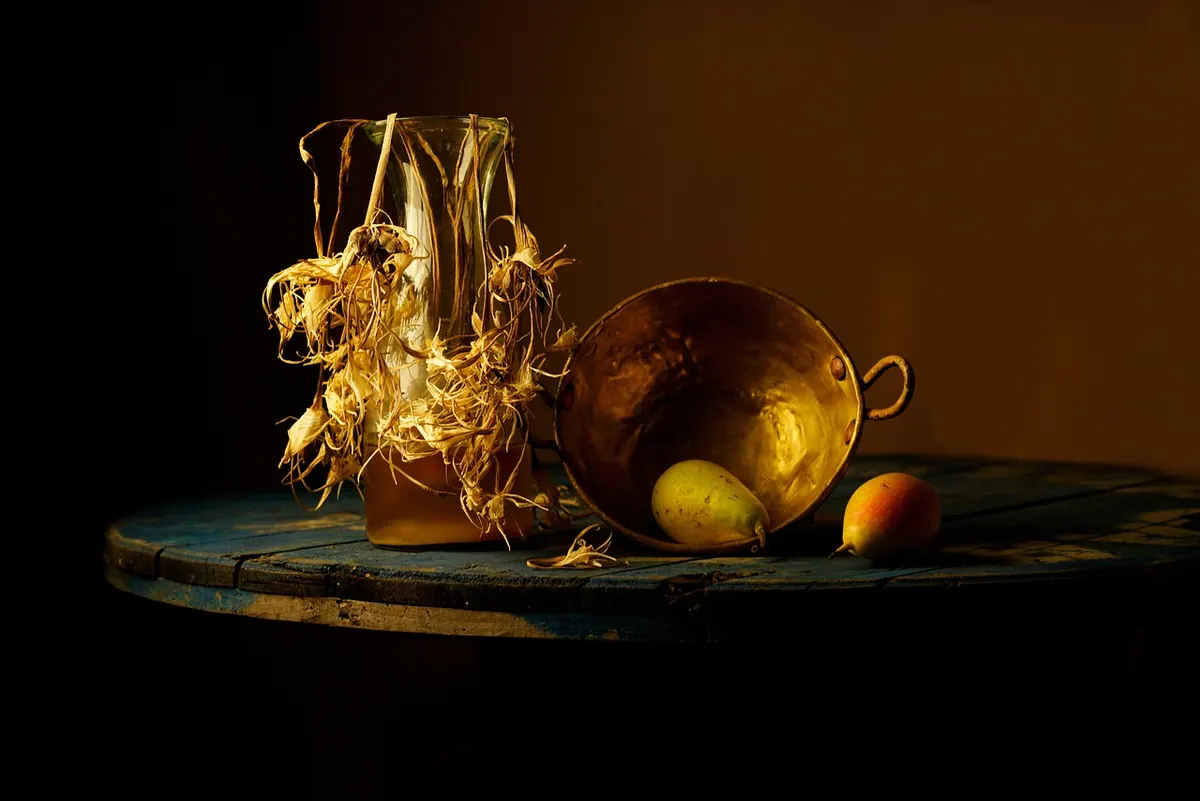
Dried flowers are preserved, not immortal. Direct sun bleaches stems and makes them brittle within weeks. A radiator, a laptop vent or a sunny windowsill pulls the last of the moisture out and turns soft grasses into dust. Damp is the opposite problem and just as damaging: near a humidifier, a steamy kitchen or a window that gathers condensation, stems go limp and then mouldy.
The best spot is usually a shaded shelf or a corner away from draughts, with a good 30cm of clearance from any heat source. If your desk sits in a bright room, turn the arrangement a quarter turn every few weeks so the same side isn't always facing the glass. It will fade more evenly and last noticeably longer.
Getting the Mechanics Wrong
Pretty stems in a wobbly arrangement will slump within days. A little hidden structure keeps everything upright and makes the display easy to rebuild later.
- Trim with the right tool. Sharp secateurs cut cleanly; kitchen scissors crush the stem and leave it splintered. Cut at a slight angle so the stem sits naturally against the vase wall.
- Strip anything that will sit inside the vase. Lower leaves and side shoots rot, shed and clutter the neck.
- Support heavy heads. Hydrangeas, alliums and large seed pods droop on thin stems. Run a length of floristry wire up the stem, or group the heavy stems at the back where they can lean on the rim.
- Weight the base. A top-heavy arrangement tips at the first nudge. A handful of clean gravel or glass beads in the bottom solves it.
- Add in three passes. Framework stems first, then the mid-length fillers, then two or three detail pieces at the front. Stop while it still looks a little unfinished.
One rule worth repeating: never add water. Dried stems standing in water go soft, then slimy, then smelly, and there is no rescuing them.
Playing It Too Safe With Colour and Texture
An all-beige arrangement photographs beautifully and can look lifeless in a room. Choose one dominant tone — soft cream, terracotta, deep burgundy — and one accent to break it up. Then think about the desk itself, because it counts as a colour. Pale ash and white surfaces flatten beige stems; walnut, black or dark green makes them sing.
Texture matters as much as colour. Pair fluffy pampas or bunny tails with something spiky or flat: dried seed heads, twisted willow, a few bleached leaves. Contrast in shape is what stops a dried display looking like a single fuzzy mass.
Arranging It Once and Never Touching It Again
Dust is the quiet killer. It dulls colour and settles deep into seed heads, and by the time it is visible, the arrangement looks tired. Once a month, hold a hairdryer on its coolest, lowest setting about 30cm away and blow gently across the display, or work over the stems with a soft make-up brush. Never use water, polish or a damp cloth.
Handle the vase rather than the flowers whenever you move it, and let go of anything that shatters at a touch, drops seeds across your keyboard or has faded to a flat grey. Spare stems should be stored flat in a box lined with tissue paper, in a dry cupboard rather than a shed or loft.
A Five-Minute Reset for a Desk Display
When an arrangement starts to look flat, don't start again from scratch. Tip the stems out, lay them on the desk and work through this:
- Remove anything broken, shedding or greyed out.
- Wipe the vase inside and out, and check the base for water marks.
- Rebuild with one or two fewer stems than last time.
- Sit in your chair and check the height against your eyeline.
- Set it back at a slight angle rather than square to the desk edge.
Dried flowers ask very little of you: no feeding, no water, no fuss. Give them a decent shape, a spot away from heat and damp, and a monthly dusting, and a single arrangement will carry a desk through a whole season. Then change it — swap the grasses for seed heads in autumn, add a deep berry tone in winter — and the display stays interesting without costing you another afternoon.
Photo: huelva3d_ / Pixabay

How to Organise Cables and Chargers Without Hiding Your Desk Decor
Cable management that keeps chargers tidy without emptying your desk: simple routes, clips, trays and...
Spring Refresh: 10 Floral Desk Decor Ideas Using British Blooms
Ten seasonal arrangements for a spring desk using British-grown blooms, plus practical advice on choosing,...
About Us