Ergonomic Workspace Ideas for a Victorian Terraced House Corner
A Victorian terrace corner rarely behaves. The chimney breast juts into the room, the alcove is a little too narrow for the desk you liked online, the floor dips towards the sash window, and the skirting board stops anything sitting flush against the wall. None of that rules out a properly ergonomic desk. It just changes the order of decisions: measure the awkward parts first, then choose furniture that fits your body and the room rather than a picture in a catalogue.
Get that order right and the corner stops feeling like a compromise. In a house where every wall has a quirk, a desk that is cut, mounted or adjusted to suit the space will almost always work better than a standard unit forced into a gap it was never meant to fill.
Measure the corner before you buy anything
Start with a tape measure and a notebook, not a website. Alcoves either side of a chimney breast vary enormously, so treat yours as unique. Measure between the skirting boards rather than the walls, because a desk has to sit in front of them or be notched around them. Then work out the available depth from the back wall to where the front edge should be, and how far a chair can travel behind you before it meets a door or a doorway.
- Width of the alcove between the skirting boards, at both its widest and narrowest points.
- Depth available, allowing for a radiator, window reveal or curtain.
- Height of the windowsill and anything fixed below it.
- Positions of sockets, radiators, the gas meter and anything you must not block.
- Floor level, checked with a spirit level at each end of the space.
Take two width measurements — one at skirting height and one at desk height — because lime plaster walls are rarely plumb, and an alcove that measures 90cm at the bottom can narrow to 86cm near the top. Note which side of the chimney breast is the external wall, too. That side will be noticeably colder and more prone to condensation behind a desk, so it pays to know before you fix anything to it.
Photograph the corner with a tape measure in shot. It makes comparing options much easier later.
Choose a desk shape that fits the awkward gap
A desk 60cm deep lets you place a monitor at roughly arm's length and still have room for a keyboard and a mug. If the corner cannot take that, go slimmer and move things onto the wall. A top 45–50cm deep with the monitor on a wall arm, or a laptop on a riser with a separate keyboard, keeps your eyes at a comfortable distance without swallowing the room.
- A worktop cut to size. A joiner can notch it around the chimney breast or taper it into an alcove, using every centimetre.
- A wall-mounted floating desk. Nothing touches the floor, so a small room feels less crowded. It must be fixed into brick, block or timber studs with suitable fixings — plasterboard alone will not hold a desk.
- A corner desk with a cut or curved front, which brings everything within reach and leaves space for paperwork.
- An adjustable-height frame with a custom top. Check the frame's width against the alcove before ordering, with a few centimetres spare for the motor housing.
- A slim console with a pull-out surface, useful where the alcove is too shallow for a full-depth desk but you still need somewhere to spread out papers.
Deal with the skirting board, not around it
The simplest fix is a small gap: set the desk 3–4cm out from the wall and let cables and the monitor arm pass through. The neater fix is to scribe the desktop to the profile of the skirting, or to mount the desk on battens fixed to the wall above it. What you should avoid is pushing a flat desk hard against a curved Victorian skirting and hoping. It will rock, and a rocking desk is the quickest way to ruin your posture.
Get the chair and the working heights right
Ergonomics is mostly a handful of measurements about your body rather than the room. When you are seated properly, your feet are flat, your thighs are roughly horizontal, your elbows rest at about 90 degrees, your wrists stay straight, and the top of the screen sits at or just below eye level. Screen distance should be about an arm's length — further for a large monitor, closer for a laptop.
Set things up in this order, because each step depends on the one before it:
- Set the chair height so your feet are flat and your thighs level.
- Add a footrest if the chair has to stay high and your feet dangle. Victorian floors dip, so a footrest also stops you chasing the slope.
- Adjust the desk to your elbows — or your elbows to the desk, using a keyboard tray or a thicker top.
- Raise the monitor until the top edge is level with your eyebrows, then tilt it slightly back.
- Move the screen to arm's length and check that the light does not bounce off it.
If the desk height is fixed and wrong, a footrest and a keyboard tray fix more posture problems than a new chair will.
In a period house, comfort comes from adjustment, not from buying the biggest desk that will fit.
Work with the light, heat and draughts
Sash windows are wonderful and awkward in equal measure. A desk facing the window looks romantic in photographs and leaves you squinting into the glare all afternoon; a desk with the window directly behind you puts a bright rectangle behind your head on every video call and throws reflections across the screen. The compromise that usually works is to sit perpendicular to the window, so daylight falls across the desk from your side.
Radiators matter too. Blocking one with a solid desk warms the underside of the desk and not the room, and it can trap heat against the wall. A wall-mounted desk with clear air underneath, or a top fixed above the radiator with its front edge projecting past the radiator's face, keeps the heat moving. Deep window reveals are useful for shallow shelving, and a heavy curtain or a Roman blind will cut the winter draught that comes off old glass.
Keep storage from eating your knee room
The classic mistake in small alcoves is a pedestal of drawers under the desk. They reduce the depth available for your knees, so you end up sitting further back, leaning forward and reaching for the keyboard. Use the height instead: shelves above the desk on the chimney breast, a narrow bookcase beside it, a pin board on the alcove wall, and a single slim drawer or a shallow basket beneath the top for the things you use daily.
Cable management is part of this. A clip-on tray under the back edge of the desktop hides the extension lead, and a few adhesive clips keep the monitor and charger cables out of the way of your feet. In a rented Victorian terrace, choose fixings you can remove and fill afterwards, and keep the furniture freestanding where you can.
Test the arrangement before you commit
Before you drill anything, mock the desk up with cardboard boxes or a sheet of board cut to the size you have in mind. Sit at it with the chair you plan to use, at the height you plan to work, and stay there for an hour. You will learn more about whether the corner works from that hour than from any set of measurements. Then check the small things: can you stand up without hitting the chimney breast, can the chair slide back far enough, does the window blind clear the monitor, and is there somewhere to put a cup of tea that is not the keyboard?
Only once those answers are yes is it worth ordering the cut worktop or drilling the bracket. A Victorian corner will never be a clean rectangle, but it can be the most comfortable place in the house to work.
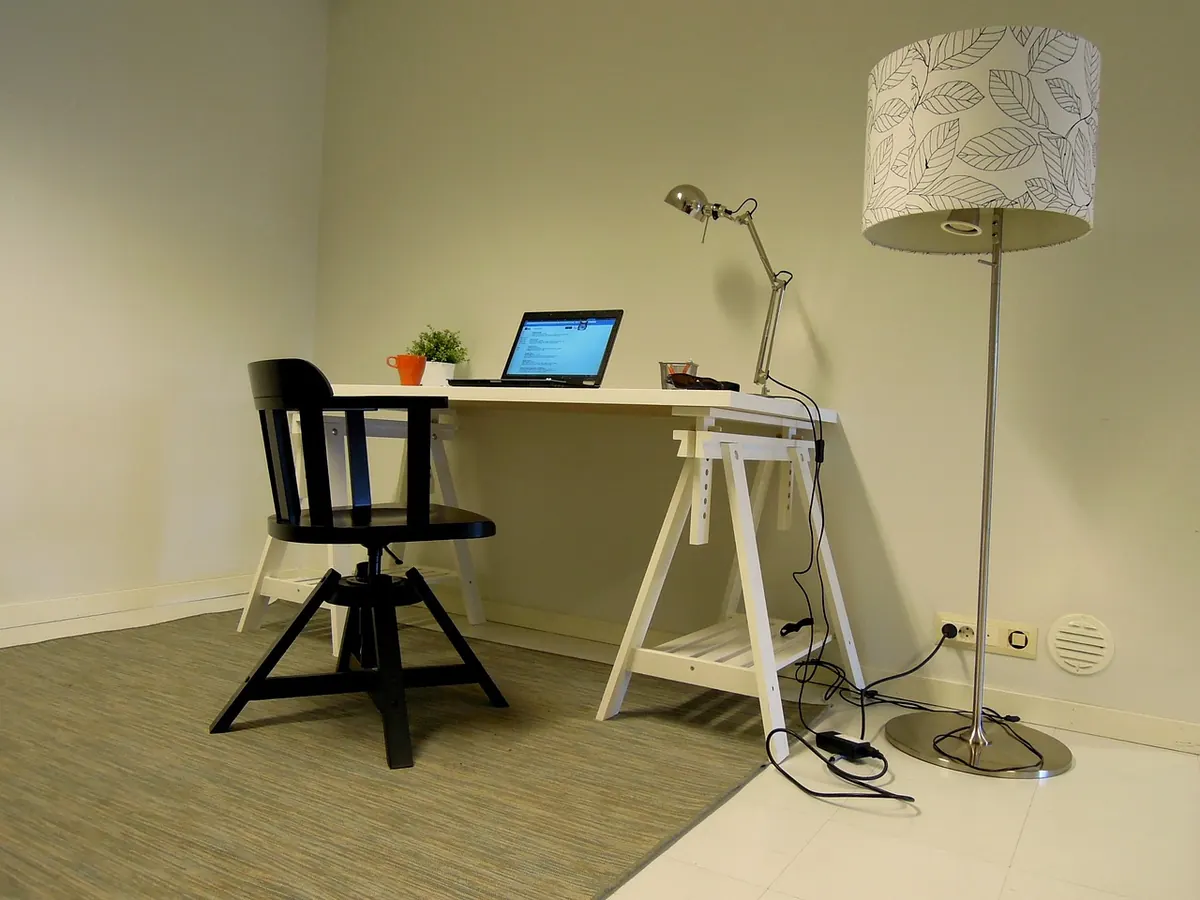
Photo: aileino / Pixabay
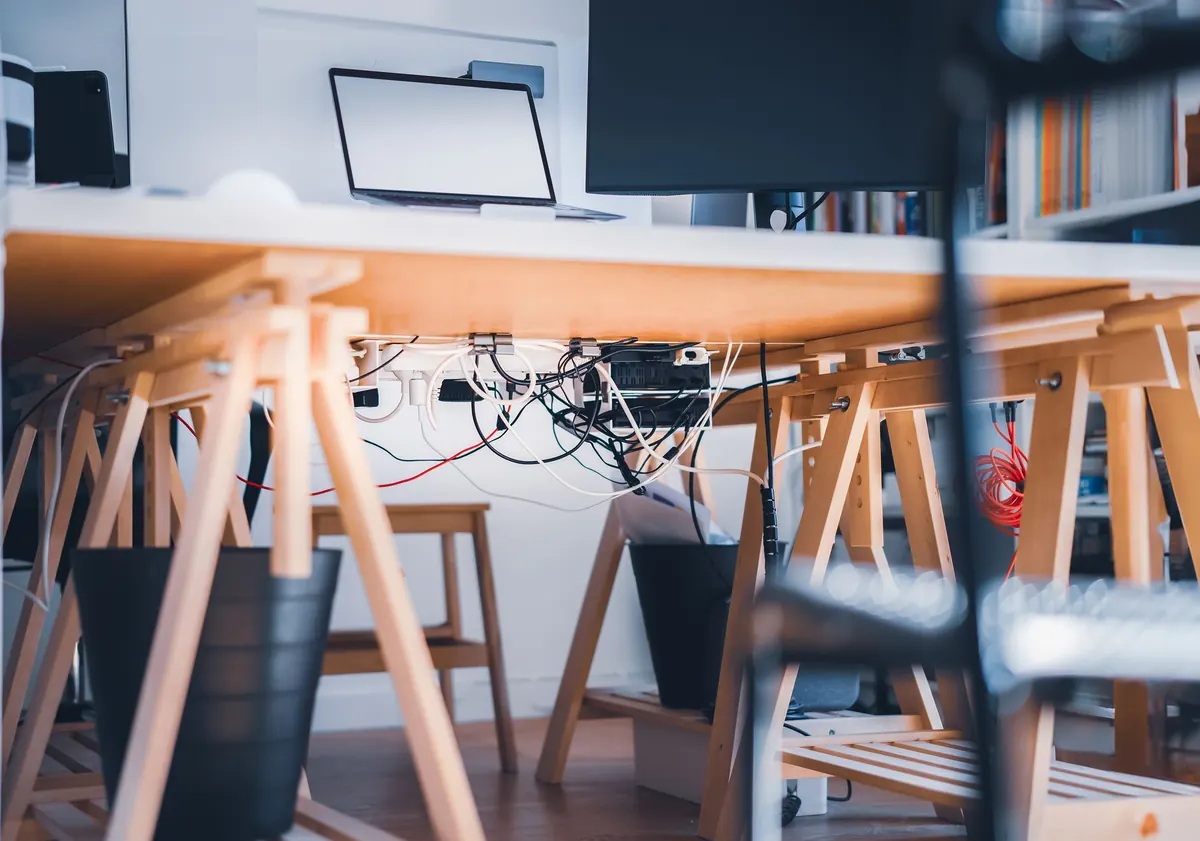
How to Organise Cables and Chargers Without Hiding Your Desk Decor
Cable management that keeps chargers tidy without emptying your desk: simple routes, clips, trays and...
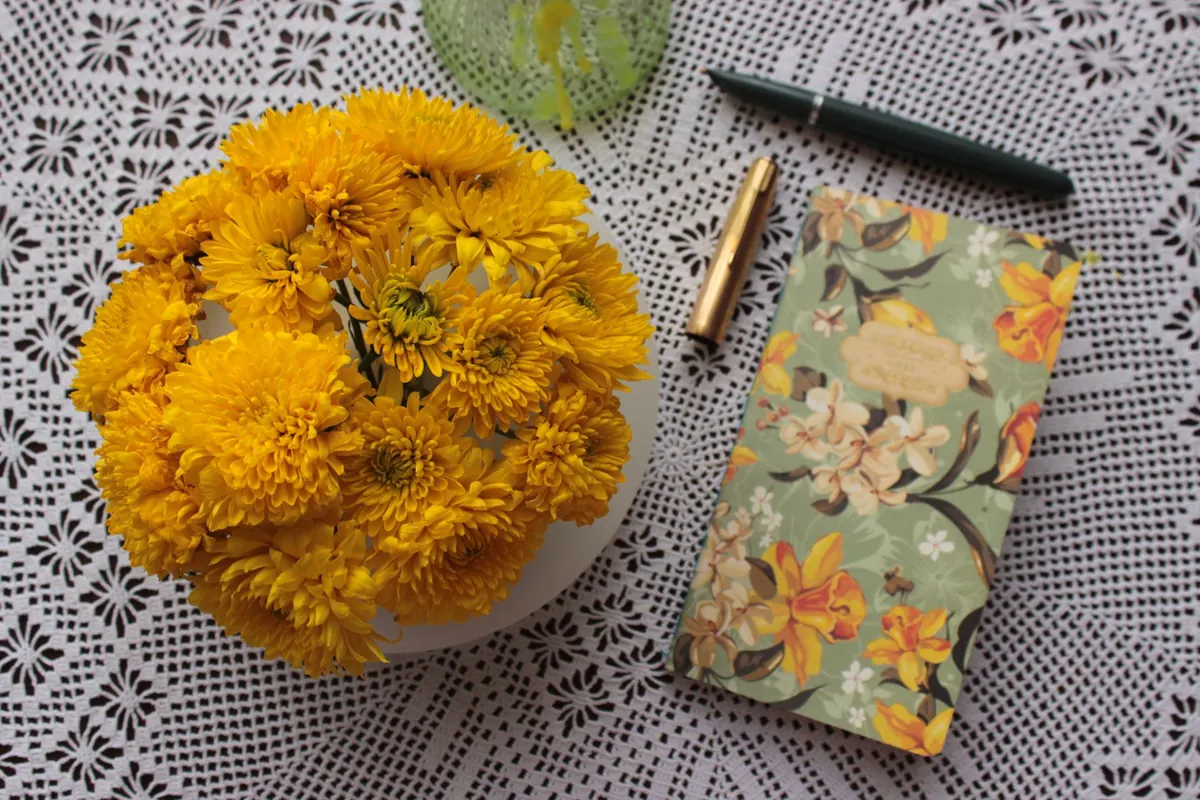
Spring Refresh: 10 Floral Desk Decor Ideas Using British Blooms
Ten seasonal arrangements for a spring desk using British-grown blooms, plus practical advice on choosing,...
About Us